Odoo SaaS Hosting Challenges & How Ksolves Solves Them
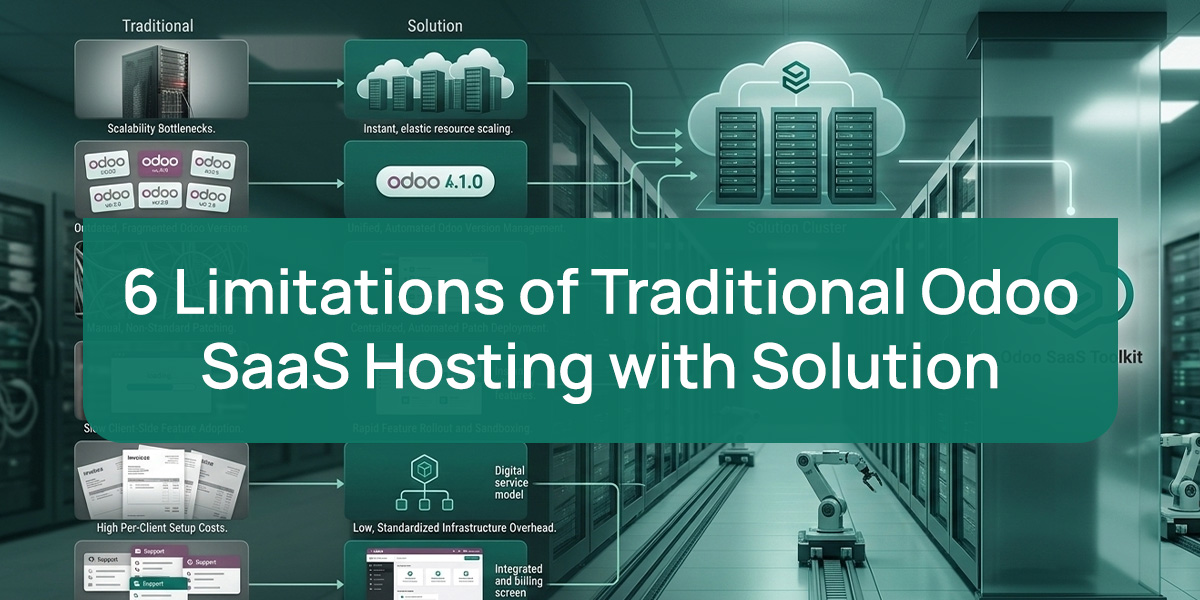
Many businesses choose traditional Odoo SaaS because it is quick to set up and requires minimal technical management. For small teams with basic operational needs, it works efficiently. However, as businesses grow, the limitations of traditional hosting start to appear. Increasing users, higher transaction volumes, and peak-hour activity can slow down the system and impact critical workflows like order processing and reporting. At the same time, companies often face restricted scalability, limited customization options, no dedicated staging environment, and rigid billing structures. Managing multiple client instances also becomes complex and time-consuming.
Platforms built on Odoo need greater flexibility as operations expand. The Ksolves Odoo SaaS Toolkit is designed to overcome these challenges by providing a scalable, secure, and flexible hosting environment. It enables businesses, resellers, and system integrators to efficiently manage multi-tenant Odoo instances while maintaining performance, customization capabilities, and operational control. In this blog, we break down the six most common Odoo hosting challenges and show precisely how Ksolves addresses each one.
Why Odoo SaaS Hosting Is Harder Than It Looks – And What to Do About It
Challenge 1: Poor Scalability on Shared Infrastructure
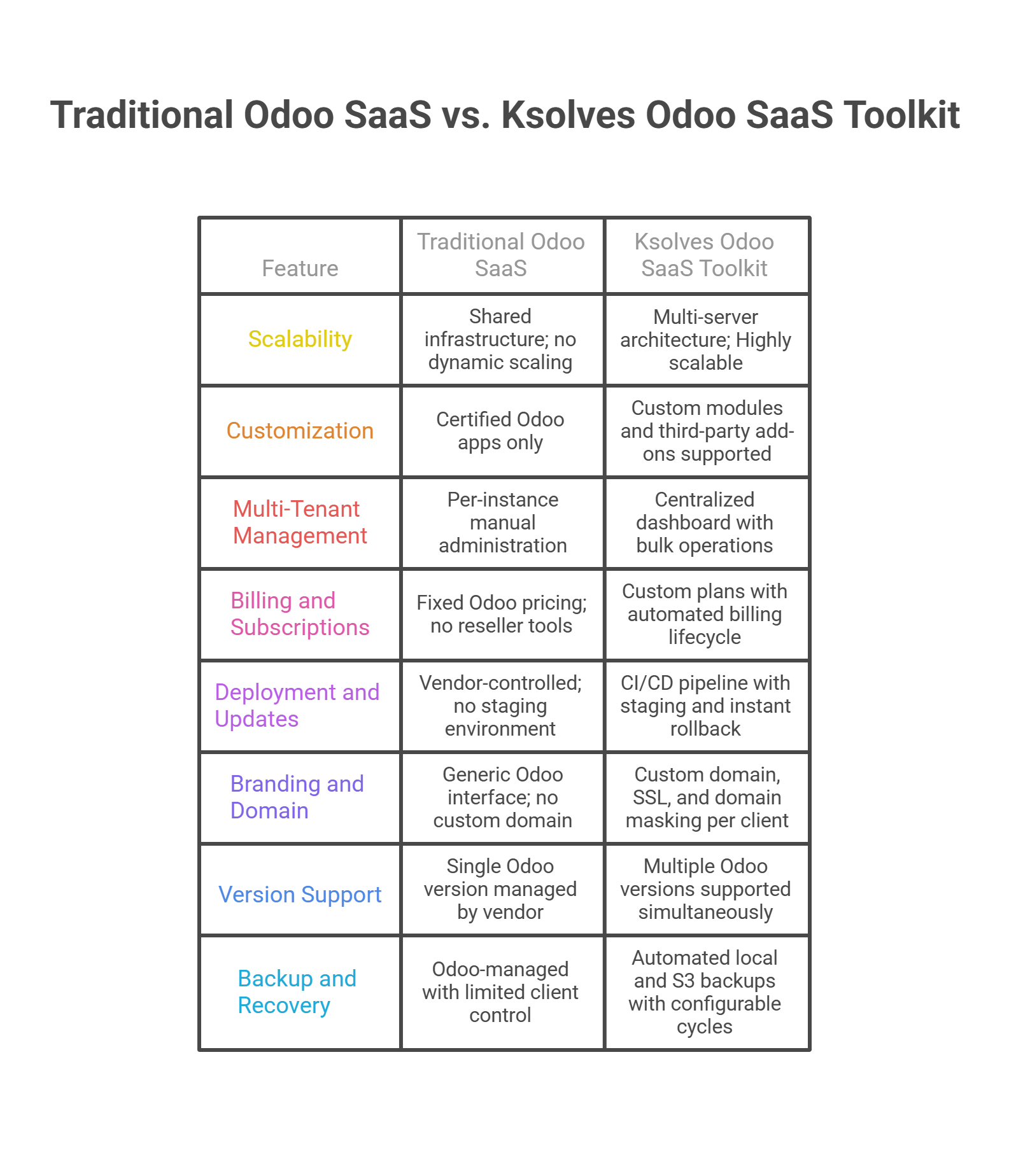
Traditional Odoo SaaS runs on a shared hosting environment. Your server resources, including CPU, memory, and processing workers, are distributed across multiple users on the same infrastructure. When your usage increases or when multiple clients are active at the same time, there is no mechanism to allocate additional resources dynamically.
Solution
The Odoo SaaS Kit by Ksolves runs on a multi-server architecture designed to scale based on real-time demand. The platform is highly scalable and supports hundreds to thousands of tenant instances while maintaining consistent performance.
Challenge-2: Customization Is Locked Down
Traditional Odoo SaaS only permits the installation of officially certified Odoo applications. Custom modules, third-party integrations, and backend development are not supported at all. For a business using Odoo for its own internal operations, this may be manageable. But for an Odoo reseller or system integrator serving clients across different industries, this restriction is a serious commercial limitation.
Solution
With the Odoo SaaS Toolkit, every client instance is independently configurable. Administrators can install custom modules, integrate third-party tools, and set up preconfigured templates tailored to specific industry requirements. Each client receives an environment built around their actual business needs rather than a standard default configuration.
Challenge 3: No Centralized Management for Multiple Clients
Traditional Odoo SaaS provides no centralized control panel for managing multiple client instances. Every administrative task, whether it is pushing an update, changing a configuration, performing maintenance, or reviewing logs, must be carried out on each instance individually.
For a business managing a growing list of clients, this creates a serious operational burden. The time required to manage 30 clients is roughly 30 times the time needed to manage one. Human error becomes more likely, deployment consistency suffers, and the more clients are added, the worse the problem becomes.
For a fuller picture of what this operational burden actually costs, see our breakdown of the hidden costs of managing multiple Odoo clients without a SaaS architecture.
Solution
Ksolve Odoo SaaS kit provides a single centralized dashboard that gives full visibility and control over all client instances at once. Bulk updates, performance monitoring, permission management, and log access are all handled from one interface. As the client base grows, administrative overhead does not grow proportionally
Challenge 4: Billing and Subscriptions Are Manual
Traditional Odoo SaaS manages billing directly between Odoo and the end user. The pricing model is fixed and designed for individual business subscriptions. There are no tools for resellers to define their own service plans, set custom pricing tiers, run managed free trials, or automate the invoicing and renewal process for their own clients.
Most Odoo resellers compensate by managing billing manually through spreadsheets or separate invoicing tools. This approach introduces errors, increases administrative workload, and becomes unsustainable as the client base grows.
Solution
Our Odoo SaaS Kit includes a complete subscription management system. Service providers can define custom plans with independent pricing, module inclusions, user limits, and trial configurations. When a client subscribes, the instance is provisioned automatically and billing runs without any manual involvement.
Challenges 5: Deployments Are Risky and Uncontrolled
Updates on traditional Odoo SaaS are applied directly by Odoo on a vendor-controlled schedule. Businesses do not choose when updates go live, and there is no staging environment where changes can be reviewed or tested before they reach the production system. If an update introduces a problem, rollback options are extremely limited.
For a business running critical operations across multiple client environments, this represents a significant risk. A single problematic update can cause disruption across every client instance simultaneously, with no fast path to recovery.
Solution
Odoo SaaS kit provides dedicated staging servers alongside a built-in CI/CD deployment pipeline. Every update or configuration change can be fully tested in an isolated environment before it is applied to production. Deployments are incremental, and instant rollback is available at any stage of the process.
Challenge 6: No Branded Experience for Your Clients
Clients accessing a traditional Odoo SaaS instance do so through Odoo’s own interface and domain. There is no ability to assign a custom domain, apply white-label branding, or mask technical URLs. Every client sees the same generic Odoo environment regardless of how the service has been packaged or positioned.
For a service provider that has invested in building a professional product identity, this creates a clear disconnect. The platform looks like Odoo rather than the service being sold, which limits premium positioning and can reduce client confidence in the product.
Solution
Each client instance on the Ksolves platform can be assigned a unique custom domain or subdomain with full SSL configuration and domain masking applied. Clients log in to a clean, professionally branded environment that reflects the service provider’s identity rather than the underlying platform.
A Real-World Scenario
Consider an Odoo consultancy managing 25 clients across retail, logistics, and finance. On traditional Odoo hosting, the team logs into each instance separately to push updates, handles billing through spreadsheets, can’t offer custom modules, and has no staging environment to test changes before they reach clients.
After switching to the Ksolves Odoo SaaS Toolkit, everything changes. Updates go to all 25 instances in a single bulk action. Billing is fully automated. Each client gets a custom domain and a tailored module setup. New clients are onboarded in minutes with quick deployment. The operational load drops significantly and the quality of service improves.
Conclusion
Traditional Odoo SaaS is a reasonable starting point for businesses with straightforward, single-instance requirements. However, for resellers, system integrators, and enterprises managing multiple clients, the platform’s structural limitations become clear very quickly. If you are still evaluating the move, our overview of the benefits of Odoo SaaS for ERP providers lays out the business case clearly.
Poor scalability on shared infrastructure, no customization support, manual multi-tenant management, inflexible billing, uncontrolled deployment processes, and the absence of branding tools are not minor gaps. They are fundamental constraints that limit what a growing Odoo business can deliver.
The Odoo SaaS Kit is designed to address all of these constraints in one platform. It gives service providers the infrastructure, automation, and control they need to deliver a professional, scalable, and reliable Odoo service to their clients without being held back by the limitations of traditional hosting.
Get started with a 30-day free trial and experience the platform in action. Contact us today to book a free Odoo SaaS demo and begin your free trial.

 1800 121 0218
  +1 (646) 203-1075
  +91 8527471031
 sales@ksolves.com